
SBTi targets: Threshold changes from April 2026
Updated: Sep 15
In April 2026 the Science Based Target initiative (SBTi) made one of their most significant changes to near-term SBTi targets by adjusting the actual reduction rates that companies need to meet.
This change has largely gone under the radar as it came about from a ‘non-substantive’ revision to the SBTi Corporate Near-Term Criteria (version 5.3.1). While the criteria didn’t change – scope 1 and 2 targets still need to be, “consistent with the level of decarbonization required to keep global temperature increase to 1.5°C compared to pre-industrial temperatures”, and scope 3 need to be, "well-below 2°C" – the formula for how this is assessed did.
We know this from changes to the tool that companies use to calculate their targets (version 2.5), which rather unhelpfully is not widely available until a company has registered through the SBTi Services portal.
The changes made affect the ‘absolute contraction method’ of target setting, which is the approached use by most companies and applies where sector-specific guidelines don’t exist.
Pre April 2026, under this approach target calculation was relatively simple for base years on or after 2020:
Scope 1 and 2 = 4.2% reduction per annum for the number of years between the target year and 2020.
Scope 3 = 2.5% reduction per annum for the number of years between the target year and 2020.
There was one nuance to this, which was that scope 1 and 2 reduction thresholds were raised if a company had already achieved a 30% or more emissions reduction after the base year but before seeking target verification with SBTi.
Since the changes introduced in April 2026 however, the situation is far more complex.
Changes to near-term SBTi targets from April 2026
There have been three key changes to the target thresholds:
1. The base year matters
Target thresholds are not related to 2020 anymore, they are related to the time between target year and base year, and so the more recent the base year, the less the reduction needed. What this means in practice, is that targets are generally lower, and thus easier to achieve, as shown by the below examples, which vary by base year but all have a target yet of 2035, base year emissions of 1000 tCO2e and most recent year emissions of 1000 tCO2e.

2. Performance matters, but not how you think
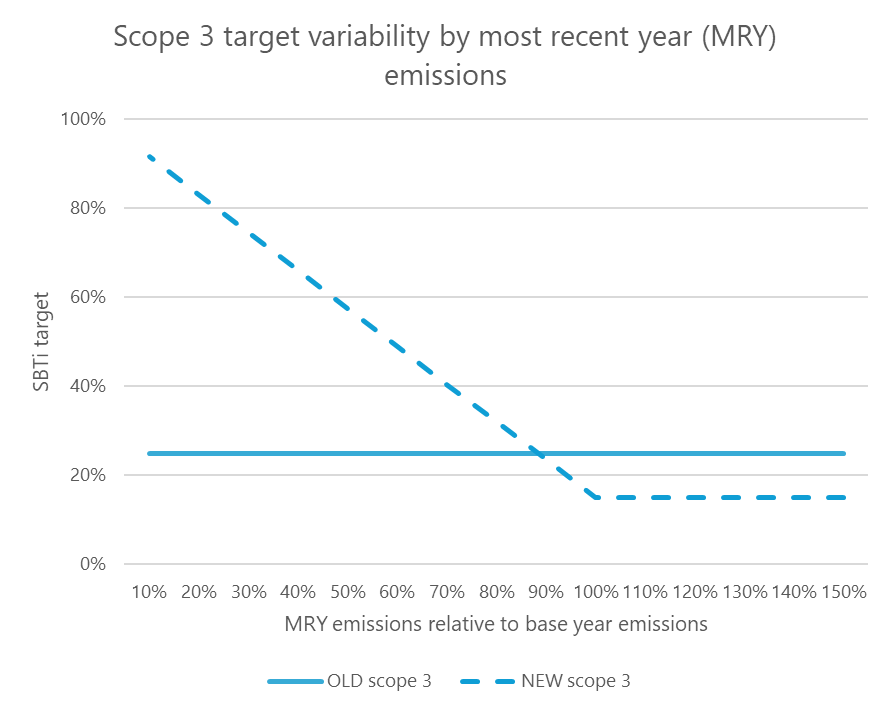
When the base year is not the most recent year (MRY), then performance to date is taken into consideration for scope 1, 2 and 3, with the SBTi setting higher reduction thresholds for companies that have already reduced their emissions. What this means in practice, is that scope 3 targets are now a lot harder to achieve if you’ve already reduced your emissions before seeking SBTi verification. Scope 1 and 2 targets are less affected as there was already a requirement to increase these if a 30% reduction had been achieved prior to target setting.
This change will be particularly galling for those organisations that have worked hard to achieve the notoriously difficult scope 3 emission reductions in their supply chain.
The below examples show the implications of various MRY emission level scenarios where the MRY is 2025, the target year is 2030 and the base year is 2024 with emissions of 1000 tCO2e.

3. Scope 1 and 2 targets are distinct
Historically companies have set one combined scope 1 and 2 target. The SBTi has been moving towards separate scope 1 targets and scope 2 targets for a little while (as per their Net Zero Standard) but this update really makes this clear as the reduction thresholds for the two scopes are no longer always the same, with thresholds for scope 2 targets generally higher than for scope 1 targets (as the SBTi expect scope 2 Net Zero to be achieved by 2040).
What this means in practice is that achieving scope 1 and 2 targets will be harder because companies can no longer rely on implementing easy scope 2 reductions (e.g. switching to renewable energy tariffs) to achieve a combined scope 1 and 2 goal. Carbon reduction plans based on a combined target will need to revisited.
Note that although performance for scope 1 and scope 2 targets must be tracked separately, they also define a 'combined scope 1 and 2 target' for communication purposes.
The below examples show the implications of various target year scenarios where the base year is 2025 with emissions of 1000 tCO2e for scope 1 and 1000 tCO2e for scope 2.

Implications of the SBTi changes in April 2026
Target setting is undoubtably more complex now. Companies need to consider a broader range of variables to set a target that is deliverable for their organisation and this will take some strategic consideration, and potentially expert advice.
Positively for some, targets will be easier than they have historically been however this won’t be the case for all. Companies that have a) already achieved significant scope 3 reductions; or b) have scope 1 emission sources that are particularly challenging to reduce, will potentially find these new target thresholds very difficult to deliver.
For help with setting your company’s carbon targets or achieving SBTi validation, contact us.
Authored by: Caroline Johnstone

